
Around the world, many regimes refuse to acknowledge the large-scale human rights violations they have committed and attempt to erase people’s public memory of these events.
In this month’s newsletter, Amnesty International Hong Kong Overseas spoke with Setenay Yarıcı, a member of Turkey’s Saturday Mothers, and Tuğçe İnce, Campaign Coordinator at Amnesty International Turkey, to explore a deeper understanding of how civil society in Turkey works to keep the history of enforced disappearances alive, the repression movement participants have faced in recent years, and how they continue to resist the authorities’ attempts to erase the truth and demand justice.
Enforced Disappearances and the Saturday Mothers
Setenay Yarıcı is 33 years old. She never met her uncle, Hayrettin Eren — he was subjected to enforced disappearance while in detention following Turkey’s military coup in 1980. Setenay only learned about her uncle’s fate when she was eleven or twelve, through accounts shared by family members and his friends. It was then that she also discovered her grandmother had been one of the founding members of the Saturday Mothers.
During the 1980s and 1990s, hundreds of people in Turkey were subjected to enforced disappearance while in police custody — Setenay’s uncle was one of them. Relatives of the victims, together with members of the Human Rights Association’s Commission on Disappearances in Custody, came together to form the Saturday Mothers, demanding the truth about their missing loved ones and accountability from the authorities.
Keeping History Alive
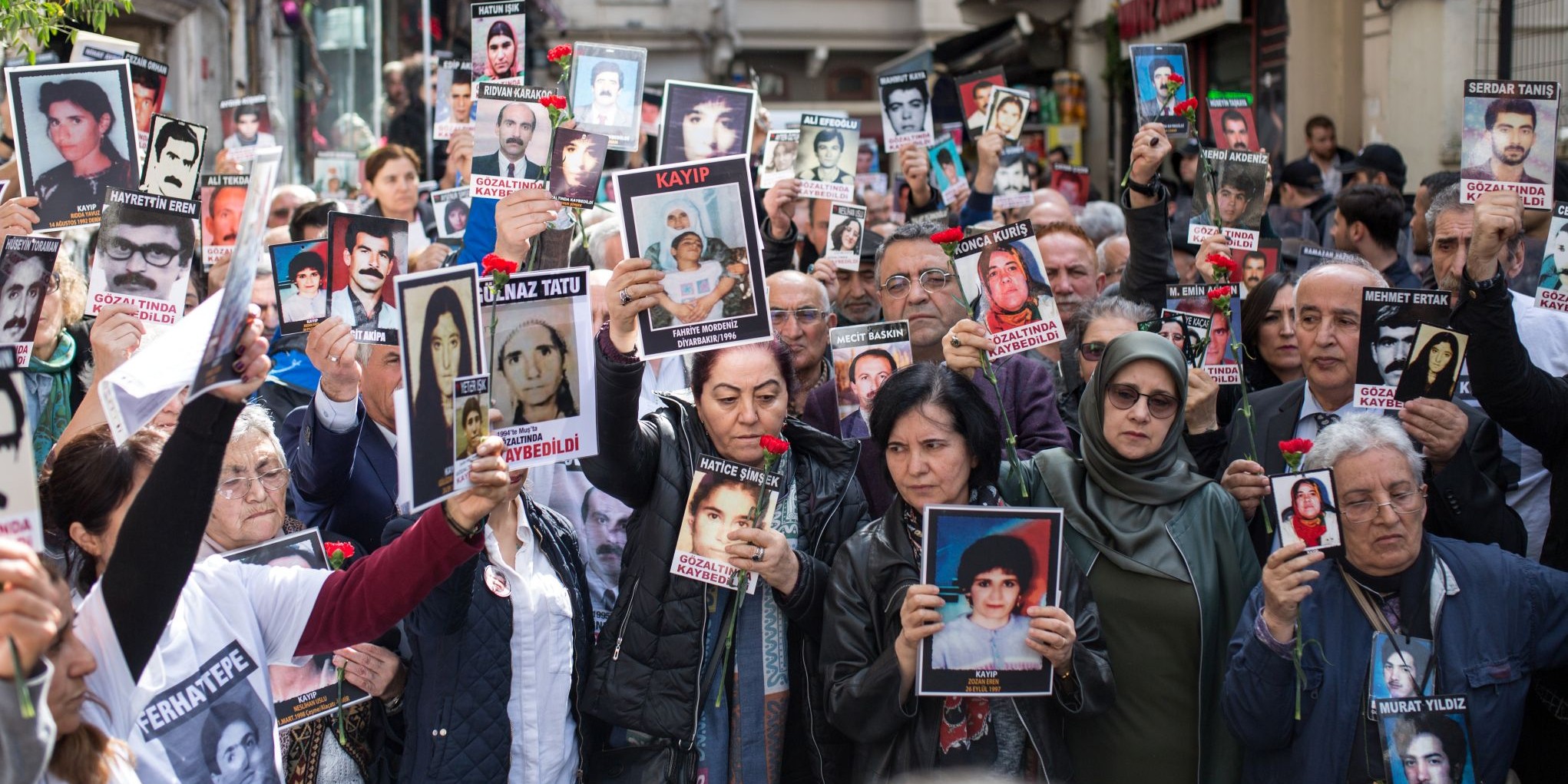
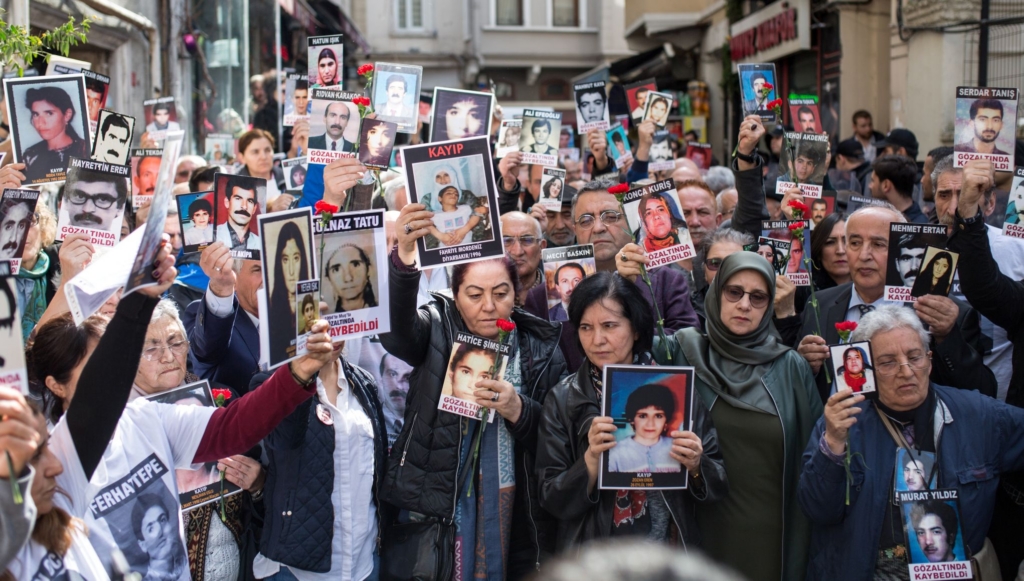
Since 1995, every Saturday at noon, the Saturday Mothers and their supporters have gathered at Galatasaray Square in Istanbul, holding photographs of their missing loved ones and carnations, reading press statements, and sharing with the public the story of one of the many disappeared. The gatherings are also livestreamed on social media.
Over the years, the Saturday Mothers have worked alongside human rights organisations, lawyers, journalists, and artists in Turkey to organise a wide range of advocacy and public education activities, raising the visibility of the collective memory of enforced disappearances and bringing this history to younger generations. At significant milestones — such as the 500th and 600th gatherings — they have organised larger-scale social media campaigns. During the annual “Week of Struggle Against Enforced Disappearances in Custody” from 17 to 31 May, they also hold panels, talks, film screenings, and exhibitions.
Escalating Repression — and Mothers Who Keep Returning
The Saturday Mothers’ sustained gatherings have brought widespread domestic and international attention to enforced disappearances and have helped curb this systemic human rights violation. Yet from their very founding, their peaceful actions have been met with police harassment, detentions, and prosecutions.
Shortly before their 700th gathering in 2018, authorities suddenly announced a ban. Police dispersed the crowd using tear gas and water cannons, 45 people were arrested, and several members were subsequently criminally charged. For an extended period afterwards, the gatherings were forced to relocate from the square to outside the offices of the Human Rights Association.
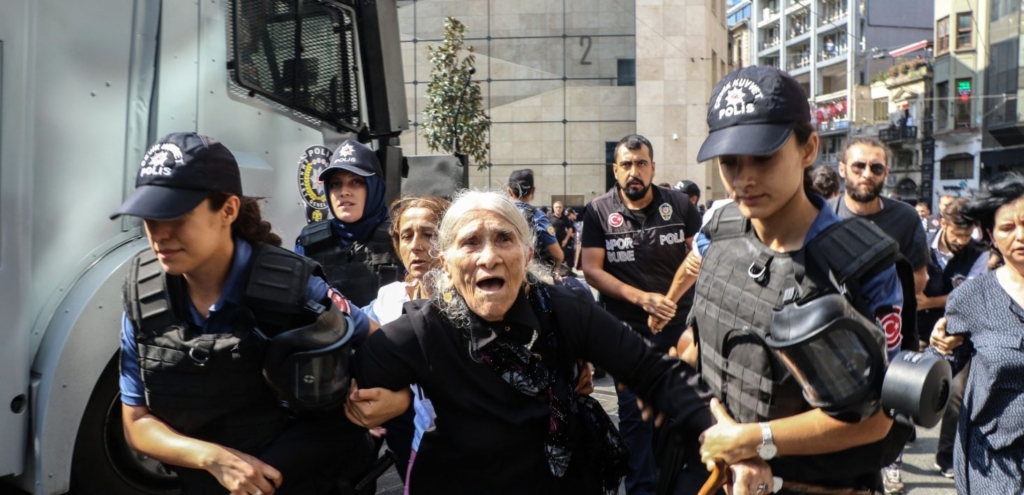
In 2023, the Saturday Mothers decided to return to Galatasaray Square. Over the following 29 consecutive weeks, every attempt to gather was met with unlawful detention, with 29 investigations and one criminal case opened against them. In November of that year, they finally returned to the square — but participation was capped at ten people, and they remained blocked behind police barriers. In March 2025, a court acquitted the 45 members arrested in 2018. Yet the acquittal has not ended the repression: restrictions on the square remain in place, the cap on numbers has not been lifted, and new prosecutions continue to be brought in connection with other gatherings.
Over the years, Amnesty International Turkey has advocated for the Saturday Mothers’ right to peaceful assembly — condemning the excessive use of force and arbitrary detention by police and monitoring the weekly gatherings and related judicial proceedings. The section has also collaborated with organisations such as the Human Rights Foundation of Turkey and the Truth Justice Memory Centre to document restrictions on assembly and other violations in accordance with OSCE standards, submitting findings to international human rights mechanisms. It has further launched public campaigns calling on the authorities to fully reopen Galatasaray Square free of any restrictions.
An Intergenerational Movement — and a Fight for the Right to Assembly
Thirty years on, the Saturday Mothers’ vision of justice has never changed: acknowledgement of the truth, revealing the fate of our disappeared loved ones, returning their remains to their families, ending impunity by prosecuting those responsible, and establishing legal safeguards and mechanisms to ensure that such violations never happen again.
In the early days of the gatherings, they would chant: “You took them away alive — we want them back alive.” In the years that followed, their question became: “We know who did it. Where are the disappeared?”
In 2011, Setenay joined the Saturday Mothers, standing in the square alongside her mother, aunt, and uncle. Reflecting on a movement that has spanned three decades, she says:
“Without addressing the Saturday Mothers’ demands for justice, there can be no genuine democracy or lasting peace. Sadly, over the years we have lost many of the mothers, fathers, and relatives of the disappeared — including my own grandmother, who was among those who stood in the square in the earliest days of the struggle. Today, the movement is carried primarily by the second generation, and by the third generation of relatives of the disappeared — people who were infants when the struggle began or had not yet been born. In this sense, the Saturday Mothers have become not only a movement for memory and justice, but a struggle of intergenerational struggle.”
Tuğçe hopes that people in Hong Kong will continue to follow and support the Saturday Mothers movement — including by joining calls on the authorities to fully restore the right to freely assemble at Galatasaray Square. She also emphasises: “This fight for memory and justice is no longer only about the history of the past, it is also about defending the rights and freedoms of Turkish society today.”
Amnesty International Hong Kong Overseas Team